
When to Migrate to Headless Commerce: 7 Proven Signs
Online stores usually start on an all-in-one platform, and that works well for a long time. But as traffic, product ranges, and marketing ambitions grow, the platform can start to feel like a ceiling. Knowing when to migrate to headless commerce helps you move at the right moment, neither too early, which wastes budget, nor too late, which costs you sales. This guide explains what headless means, the signs it’s time, how it affects performance, what it costs, and how to plan the move.
What Is Headless Commerce?
Headless commerce separates the front end, which is what customers see, from the back end, which handles products, pricing, checkout logic, and orders. The two communicate through APIs, so you can change one without disturbing the other. Here is how the pieces fit together:
- Front end: The website, mobile app, kiosk, or any other place customers shop
- Back end: The product catalog, inventory, payments, and order management
- API layer: The connection that delivers data between front end and back end
- Content system: A separate CMS that manages pages, banners, and editorial content
In a traditional platform, these parts are bundled together. In a headless setup, they are independent. Understanding that difference is the first step in deciding when to migrate to headless commerce.
Traditional vs Headless: A Quick Comparison
- Design freedom: Traditional stores rely on templates, while headless stores allow fully custom experiences
- Channels: Traditional platforms focus on the website, while headless supports apps, social, and in-store screens from one back end
- Speed to launch: Traditional is faster, while headless takes longer to build
- Maintenance: Traditional is simpler, while headless means more components to manage
- Cost: Traditional is lower upfront, while headless needs a higher initial investment
- Flexibility: Traditional is limited by the platform, while headless lets you swap tools freely
When Should You Migrate?
The decision rarely hinges on one factor. These signs suggest it’s time to seriously consider when to migrate to headless commerce:
- You sell across several channels and struggle to keep experiences consistent
- Template limits stop your designers from building what they imagine
- Pages remain slow even after repeated optimization
- Stacked apps and plugins slow the site and create conflicts
- You need personalized content and offers for different customer groups
- International expansion demands different languages, currencies, and layouts
- Every front-end change requires developer involvement
- Complex integrations with ERPs, loyalty tools, or custom systems keep breaking
Staying on your current platform is perfectly reasonable when:
- Your catalog and checkout are straightforward
- You sell mainly through one website
- Your team is small, with limited development resources
- Budget is tight, and speed to market matters most
How Headless Storefronts Are Built
Many teams build the front end with React, and a React ecommerce storefront is one of the most popular headless approaches. Using frameworks built on React, developers can create fast, interactive shopping experiences with reusable components. A typical setup includes:
- A React-based front end for product pages, search, and checkout
- A commerce back end that manages catalog, pricing, and orders
- A headless CMS for content editors
- Third-party services for payments, search, and email
- A content delivery network to serve pages quickly worldwide
Does Headless Improve Performance?
It can, but not automatically. When built well, headless architecture helps in several ways:
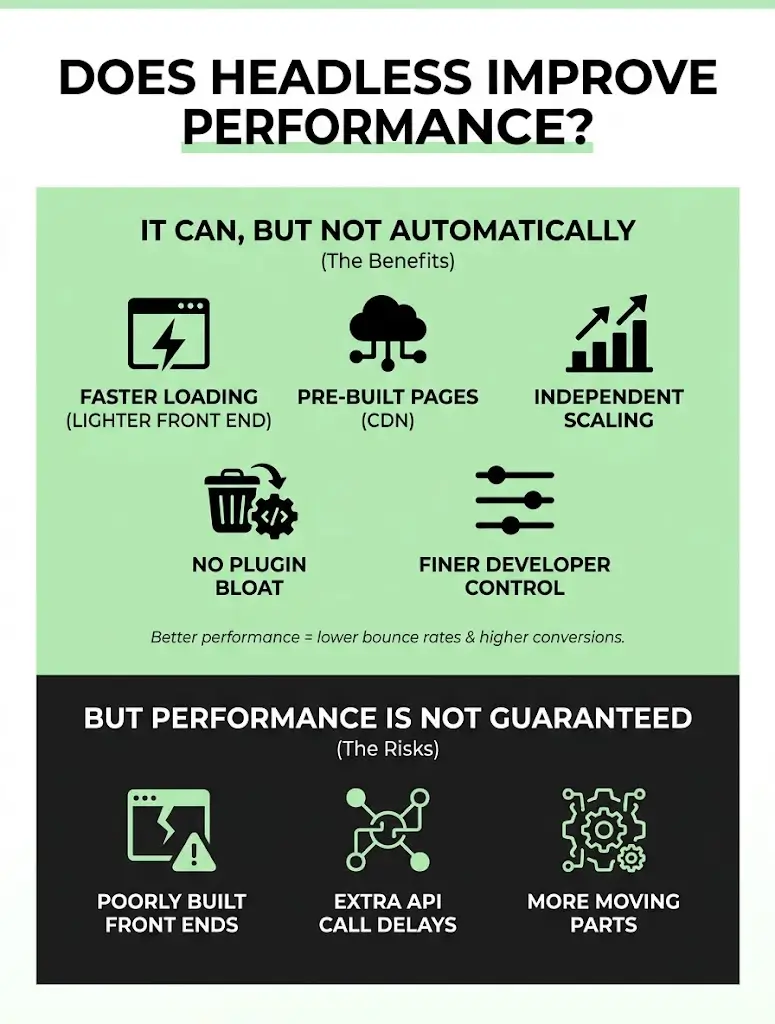
- Lighter front ends load faster than template-heavy pages
- Pages can be pre-built and served from a content delivery network
- Front end and back end scale independently during traffic spikes
- Unused scripts and plugin bloat can be removed
- Developers have finer control over images, fonts, and loading order
Better storefront performance often means lower bounce rates and higher conversion, which is why speed is one of the most measurable benefits. However, performance is not guaranteed:
- Poorly built front ends can be slower than the platform they replaced
- Extra API calls can add delay without proper caching
- More moving parts require careful monitoring
Performance alone is rarely the only reason for when to migrate to headless commerce, but it is often the easiest benefit to prove.
What Are the Main Benefits?
- Creative freedom: Design any experience without template restrictions
- Omnichannel selling: Serve web, mobile apps, and in-store displays from one system
- Faster iteration: Front-end teams can ship changes without touching the back end
- Best-of-breed tools: Choose the best search, payments, and content tools for your needs
- Future flexibility: Replace one component without rebuilding everything
Many companies pair this approach with composable commerce, where each function, such as search, checkout, or content, is a separate, replaceable service. It gives you maximum flexibility, but it also requires stronger technical planning.
What Are the Costs and Trade-offs?
Headless is an investment, and it comes with real trade-offs:
- Higher upfront cost: Custom front-end development takes more time and budget
- More moving parts: Several services must work together reliably
- Ongoing maintenance: Updates, monitoring, and security span multiple systems
- Skill requirements: You need developers comfortable with APIs and modern front-end frameworks
- Lost conveniences: Some built-in previews, themes, and one-click apps may no longer apply
Weigh these costs against your growth plans and revenue upside when deciding when to migrate to headless commerce.
How to Plan Your Migration
A phased plan reduces risk and downtime:
- Audit your current store: List apps, integrations, traffic sources, and pain points.
- Define goals: Choose measurable targets such as page speed, conversion rate, or new channels.
- Select your stack: Decide on the front-end framework, commerce back end, and CMS.
- Design the experience: Prototype key pages before development begins.
- Migrate in phases: Start with one section, such as the homepage or product pages, then expand.
- Protect SEO: Map redirects, preserve metadata, and monitor rankings closely.
- Test thoroughly: Check speed, checkout, mobile behavior, and integrations.
- Launch and optimize: Track results against your baseline and refine continuously.
A clear plan turns when to migrate to headless commerce into a business decision rather than a technical gamble.
Common Mistakes to Avoid
- Going headless because it is trendy rather than necessary
- Underestimating ongoing maintenance and hosting costs
- Neglecting SEO during the migration
- Rebuilding everything at once instead of phasing the move
- Skipping training for content and marketing teams
- Forgetting to set performance and conversion baselines
How Technexia Can Help
Technexia is an AI-powered digital innovation partner that combines strategy, automation, data intelligence, and AI systems to build scalable digital ecosystems. Our services support every stage of your ecommerce evolution:
- AI & Data: AI portals, automation, data science, intelligent solutions, and smart systems for personalization, recommendations, and demand insights
- Development: web and mobile platforms and ecommerce ecosystems built with WordPress, .NET, React, Shopify, and Webflow, including React ecommerce storefronts and composable commerce architectures
- UI/UX Design: prototyping, branding, and experience flows that turn browsers into buyers and improve storefront performance
- Digital Growth: SEO, Google Ads, performance marketing, and analytics to protect rankings and grow revenue through the transition
We work across tourism and hospitality, real estate, education, transportation, and healthcare, as well as retail brands, helping each business understand when to migrate to headless commerce and how to do it safely.
Conclusion
Headless architecture is powerful, but it is not for everyone. If your store is hitting design limits, struggling with speed, selling across multiple channels, or fighting integration problems, it may be time to look closer. If your needs are simple, your current platform may serve you well for years. Evaluate your goals, budget, and team honestly, and phase the move carefully to understand when to migrate to headless commerce for your business.
Ready to find out if your store is ready? Contact Technexia today to book a consultation and get a tailored ecommerce roadmap built around your growth goals.
Frequently Asked Questions
Can I go headless gradually instead of all at once?
Yes. Many stores start by rebuilding a single section, such as product pages or the homepage, and expand once results are proven.
Will going headless hurt my SEO rankings?
It can if redirects, metadata, and page structure are not handled carefully. With proper planning, rankings can be preserved or even improved.
Is headless only for large enterprise brands?
No. Mid-sized stores with complex needs can benefit too, though smaller stores with simple requirements often do better on a traditional platform.
How long does a typical migration take?
Timelines vary by scope. A focused phase can take a few weeks, while a full rebuild commonly takes a few months.
What skills does my team need after launch?
You’ll need people comfortable with APIs and modern front-end development, or a development partner who can provide ongoing support and updates.