
AI & Automation
Chatbots and agents are often mentioned together, and many people think they are the same thing. They are not. Knowing the AI agent vs. chatbot difference helps you pick the right tool and avoid wasted budget. A chatbot mostly talks, while an agent can plan and act. This guide explains both in simple words and shows how each fits into your business AI plans.
What Is a Chatbot?
A chatbot is software that talks with people through text or voice. It answers questions, shares information, and guides users through simple steps. Early versions followed scripts and menus. Today, an AI chatbot uses language models to understand free text and reply in a natural way.
Common uses include:
- Answering frequently asked questions
- Sharing opening hours, prices, and policies
- Collecting basic details such as a name and email address
- Passing the conversation to a human when needed
A chatbot is easy to launch, low in cost, and quick to answer. But it usually stays inside the conversation. It cannot complete tasks across several systems on its own, and it can lose track of context in long requests. Understanding these limits is the first step in the AI agent vs. chatbot comparison.
What Is an AI Agent?
An AI agent is a system that can pursue a goal. It plans steps, uses tools, and takes action with limited human help. Where a chatbot answers, an agent works. AI agents can search, read files, send emails, update records, and check their own results, then try again if something fails. This style of work is often called agentic AI.
Most agents have these parts:
- A clear goal
- A plan with steps
- Access to tools such as email, calendars, or databases
- Memory of what has already been done
- A loop that checks results and adjusts
That ability to act is the heart of the AI agent vs. chatbot debate.
Can AI Agents Perform Actions?
Yes, within the limits you set. An agent connects to tools such as calendars, email, customer records, and ticket systems, so it can do real tasks. For example, it can:
- Book a meeting after checking calendars
- Refund a small order that fits your policy
- Update a customer record
- Draft and send a follow-up email
- Create a support ticket and assign it
Because AI agents can act, they need clear rules:
- Limit what the agent is allowed to access
- Require human approval for big actions
- Keep logs of everything it does
- Test the agent before you launch it
This is where agentic AI needs more care than a chatbot, since mistakes can have real effects. In AI agent vs. chatbot decisions, action is the biggest difference.
7 Smart Differences Between an AI Agent and a Chatbot
The AI agent vs. chatbot differences are easiest to see side by side:
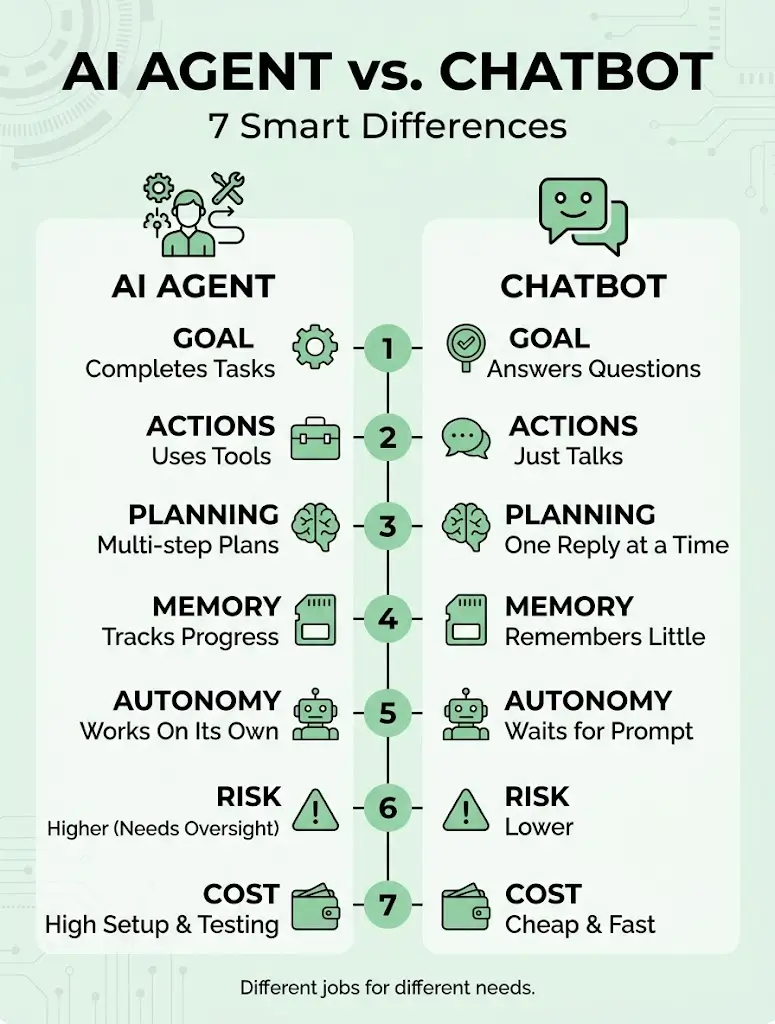
- Goal: A chatbot answers questions, while an agent completes tasks.
- Actions: A chatbot talks, while an agent uses tools to act.
- Planning: A chatbot replies one message at a time, while an agent plans several steps.
- Memory: A chatbot often remembers little, while an agent tracks progress toward its goal.
- Autonomy: A chatbot waits for each prompt, while an agent can work on its own within limits.
- Risk: A chatbot carries lower risk, while an agent needs closer oversight.
- Cost and setup: A chatbot is cheaper and faster to launch, while an agent needs more setup and testing.
A good AI chatbot can still be very useful. It simply does a different job.
When Should a Business Use Each?
Choose a chatbot when you need:
- Quick answers to common questions
- Simple customer support
- Lead capture on your website
Choose an agent when you need:
- Multi-step tasks that follow a goal
- Work across several systems
- Relief from repetitive back-office work
Many companies use both. The chatbot talks to the customer, and an agent works behind the scenes to complete the request. Many teams start with a chatbot and add AI agents later as part of a wider business AI plan. The best AI agent vs. chatbot choice depends on the job, not on the hype.
Common Mistakes to Avoid
- Expecting a chatbot to complete complex tasks
- Giving an agent too many permissions at once
- Skipping testing before launch
- Removing human review from important decisions
- Starting without a clear goal
- Ignoring data privacy rules
Most AI agent vs. chatbot problems come from using the wrong tool for the job.
Conclusion
A chatbot talks, and an agent acts. Both have a place, and the right choice depends on your goals, your risk level, and your budget. Start with a simple AI chatbot if you need quick answers, move to agents when you need real task completion, and keep humans in the loop for important steps. A clear view of AI agent vs. chatbot makes your business AI decisions simpler and safer.
Ready to choose the right tool? Contact our team today and get clear, practical guidance for your business.
Frequently Asked Questions
Is the line between an AI agent vs. chatbot always clear?
Not always. Some chat tools can take simple actions, and some agents have a chat window. The key question is whether the tool can plan and act toward a goal.
What is the difference between agentic AI and generative AI?
Generative AI creates content such as text or images. Agentic AI uses that ability, plus tools and planning, to complete tasks.
Is an agent more expensive than a chatbot?
Usually yes, because it needs more setup, testing, and monitoring. It can also save more time when it handles full tasks.
Are agents safe to use with company data?
They can be, if you limit access, keep logs, and follow your data protection rules. Always require approval for sensitive actions.
Can a chatbot be upgraded into an agent?
Often yes. You can connect a chatbot to tools and give it goals and rules, but you should test carefully before you let it act.