
AI & Automation
Every business reaches a point where generic tools no longer match how it actually works. That is usually when leaders start asking what is custom software development, and whether it is worth the investment. In simple terms, it is the process of designing, building, and maintaining software created for one organization’s needs rather than for a mass market. This guide explains what it involves, how it compares with SaaS, and how to tell when it is the right move.
What Is Custom Software?
Custom software is an application built around your workflows, data, and goals. Think of custom business software as a tailored suit: it fits because it was measured for you. Common examples include:
- Customer portals with personalized dashboards
- Booking, scheduling, and dispatch systems
- Inventory and order management tools
- Internal platforms that automate approvals and reporting
- Mobile apps designed around a specific service
- Integration layers that connect your existing systems
When people ask what custom software development is as a discipline, the answer covers the full lifecycle: discovery, design, engineering, testing, launch, and ongoing support. Good software development is as much about understanding the problem as it is about writing code.
How Does It Differ From SaaS?
SaaS products are ready-made applications you rent by subscription. They are quick to start and work well for common needs. Off-the-shelf software like this is built for thousands of customers at once, which shapes what it can and cannot do. Here is how the two approaches compare:
- Fit: SaaS offers a general fit, while custom builds match your exact process
- Launch speed: SaaS can start in days, while custom builds take weeks or months
- Cost model: SaaS charges recurring fees per user, while custom builds need a larger upfront investment
- Ownership: With SaaS you rent access, while with custom builds you own the system and its data
- Integration: SaaS depends on available connectors, while custom builds connect to anything you need
- Roadmap control: The vendor decides SaaS features, while you decide what a custom system does next
- Flexibility: SaaS changes only within set options, while custom systems evolve with your business
Seeing these differences clearly is central to understanding what is custom software development and where it sits next to subscription tools.
When Is Custom Development Worth It?
Not every company needs a custom build. It tends to be worth the investment when:
- Your workflow is a competitive advantage that generic tools cannot support
- You pay for several subscriptions that still leave gaps
- Compliance or security rules demand tighter control over data
- You need real-time connections between multiple internal systems
- Growth is making per-user subscription fees increasingly expensive
- Your team spends hours each week on workarounds and manual re-entry
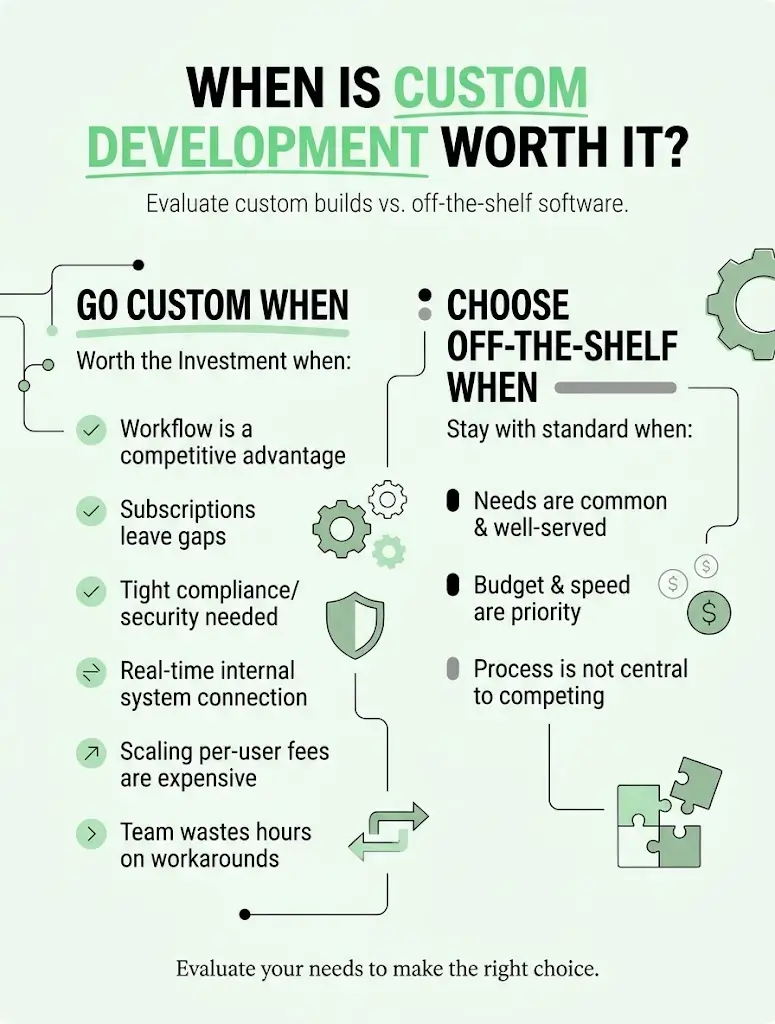
Meanwhile, off-the-shelf software remains the better choice when:
- Your needs are common and well served by existing tools
- Budget and speed matter more than customization
- The process is not central to how you compete
Asking what is custom software development only helps if it leads to this kind of honest comparison.
Signs You Might Need Custom Software
Certain patterns show up repeatedly in companies that outgrow ready-made tools:
- Spreadsheets are patched together to fill gaps in your software
- Staff retype the same data into several systems
- Customers complain about clunky or inconsistent experiences
- Reports take hours because data lives in different places
- New hires need long training to navigate your tool maze
- Every feature request ends with “the software can’t do that”
If several of these sound familiar, custom business software may be the cleaner long-term answer.
How Does the Process Work?
A structured process keeps projects on time and on budget. Every build starts with a clear list of software requirements, and the stages usually look like this:
- Discovery: Teams study your goals, users, and current processes.
- Requirements: You define must-have features, integrations, and success measures.
- Design: Wireframes and prototypes show how the system will look and behave.
- Build: Engineers develop the system in short cycles, with regular demos.
- Testing: Quality checks cover functionality, security, speed, and usability.
- Launch: The system goes live, often in phases to reduce risk.
- Support and improvement: Updates, monitoring, and new features follow real usage.
Knowing these stages makes what is custom software development far less mysterious and helps you plan time and money.
What Does It Cost?
Pricing varies widely because every project is different. Several factors drive the final number:
- Scope: The number of features and user types
- Integrations: How many outside systems must connect
- Design complexity: Simple interfaces cost less than highly customized ones
- Security and compliance: Regulated industries need extra safeguards
- Timeline: Faster delivery often means larger teams
- Maintenance: Hosting, updates, and support continue after launch
Cost is the question behind what is custom software development for most buyers, and you can keep it manageable with these habits:
- Start with a minimum viable product and expand over time
- Prioritize features by business impact
- Phase the rollout across teams or departments
- Compare total cost over several years, not just the first invoice
Common Mistakes to Avoid
- Starting without clear software requirements, which leads to scope creep
- Skipping user feedback during design and testing
- Trying to build everything in the first release
- Ignoring maintenance and support budgets
- Choosing a vendor on price alone
- Leaving no internal owner to guide decisions
How Technexia Can Help
Technexia is an AI-powered digital innovation partner that combines strategy, automation, data intelligence, and AI systems to build scalable digital ecosystems. If you are exploring what is custom software development for your own company is, our team can guide you from idea to launch. Our services include:
- AI & Data: AI portals, automation, data science, intelligent solutions, and smart systems that make your software smarter
- Development: web and mobile platforms, AI-powered portals, and ecommerce ecosystems built with WordPress, .NET, React, Shopify, and Webflow
- UI/UX Design: prototyping, branding, and experience flows that make new systems easy to adopt
- Digital Growth: SEO, Google Ads, performance marketing, and analytics to support growth after launch
Our Innovation Method moves through six stages: Insight and Discovery, Strategy and Architecture, Experience and Design, Intelligent Development, Performance and Optimization, and Growth and Evolution. We work with tourism and hospitality, real estate, education, transportation, and healthcare businesses, tailoring each solution to real goals.
Conclusion
Understanding what is custom software development gives you a clearer way to judge your options. Custom builds shine when your workflow is unique, your systems need to connect, or subscriptions no longer fit. Ready-made tools remain smart for standard needs. Strong software development starts with clear requirements, a phased plan, and a partner who listens.
Still asking what is custom software development for your specific case? Contact Technexia today to book a consultation and get a tailored recommendation for your business.
Frequently Asked Questions
How long does a typical project take?
Simple tools can be ready in a few weeks, while larger systems with many integrations usually take several months. Phased delivery lets you start using key features earlier.
Who owns the source code?
Ownership depends on your agreement, so confirm it in writing before the project begins. Many businesses require full ownership of both the code and the data.
Can a custom system work alongside the tools I already use?
Yes. Modern builds connect to CRMs, accounting platforms, payment gateways, and communication tools through APIs, so you do not have to replace everything at once.
What happens after launch?
Most systems need ongoing support, including security updates, bug fixes, performance monitoring, and new features as your business evolves.
Is this only realistic for large companies?
No. Small and mid-sized businesses benefit too, especially when they begin with a focused first release and grow the system gradually.