
AI & Automation
Every business wants to save time and reduce errors, but the tools to do it are changing fast. Many leaders ask a simple question: which approach is better? Understanding AI automation vs. traditional automation helps you choose the right tool for each job. In short, one follows fixed rules, while the other learns and adapts. This guide explains both in simple words, so you can decide with confidence.
AI automation is changing how businesses manage repetitive tasks, process information, and improve operational efficiency. Unlike traditional automation, which relies on predefined rules, AI-powered systems can interpret information, adapt to different inputs, and support more complex workflows. Understanding what AI automation is and how it helps businesses is essential when deciding which processes to automate and which technologies to adopt. By exploring its key benefits and practical applications, you can identify opportunities to improve productivity and build more efficient business operations.
How Does Traditional Automation Work?
Traditional automation follows fixed rules written by people. You decide the steps, and the system repeats them exactly. If this happens, then do that. It works well for predictable tasks with clear inputs, such as payroll runs, invoice reminders, scheduled reports, and copying data between systems.
Two common forms are:
- Robotic process automation, where software bots click, type, and copy data like a person would
- Workflow automation, where tasks move between steps and people based on set rules
The key point in AI automation vs. traditional automation is that traditional systems do exactly what they are told, nothing more.
Its strengths are easy to see:
- Fast and predictable results
- Easy to audit and explain
- Low running cost for stable processes
Its limits are just as clear:
- It breaks when a form or format changes
- It cannot handle messy inputs such as free-text emails or images
- It needs manual updates when the process changes
What Does AI Add to Automation?
AI adds the ability to learn from data, handle messy inputs, and make decisions. It can read emails, understand text, spot patterns, and improve with feedback. When AI is combined with rules and bots, the result is often called intelligent automation.
Here is what AI brings to the table:
- It understands unstructured data such as documents, emails, and images
- It makes predictions and recommendations
- It handles exceptions that a fixed rule cannot cover
- It improves over time as it sees more examples
- It supports natural language chat with customers and staff
AI can also make mistakes, so people should review important decisions. This is the biggest step forward in AI automation vs. traditional automation: the system moves from following steps to using judgment.
AI Automation vs. Traditional Automation: Side-by-Side Comparison
Both approaches support business process automation, which simply means improving how work flows across a company.
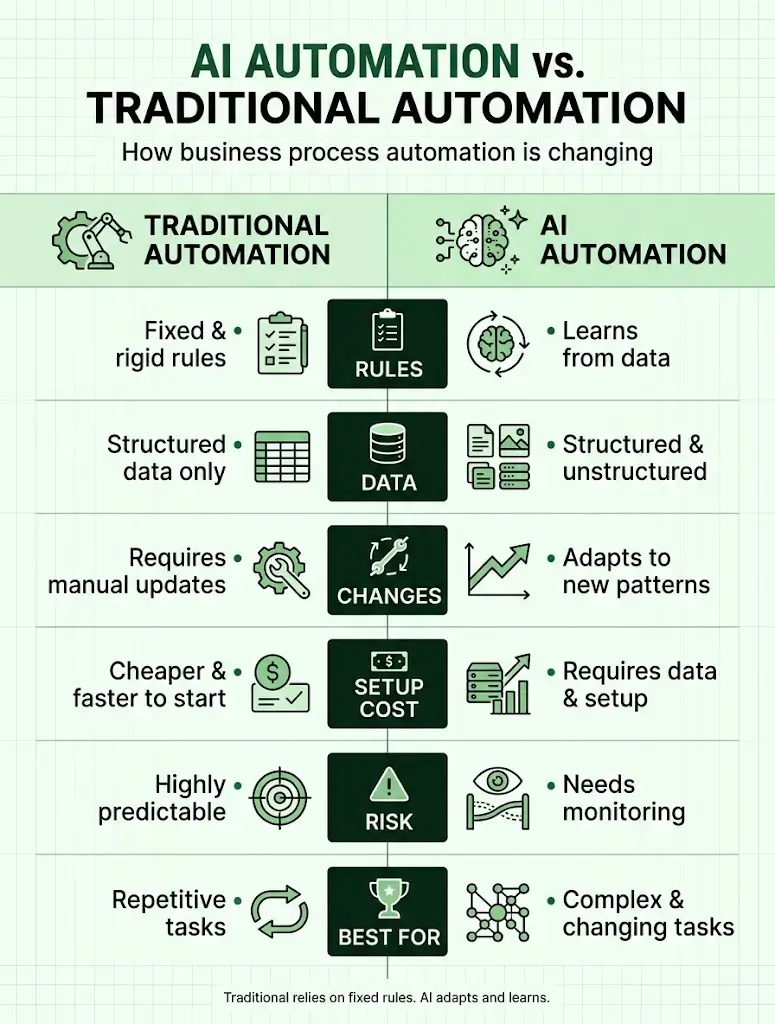
The difference is in how they do it:
- Rules: Traditional systems follow fixed rules, while AI learns from data
- Data: Traditional systems need structured data, while AI can read structured and unstructured data
- Changes: Traditional systems need manual updates, while AI can adapt to new patterns
- Setup cost: Traditional tools are usually cheaper to start, while AI often needs more data and setup
- Risk: Traditional results are predictable, while AI results need monitoring
- Best for: Traditional tools suit repetitive tasks, while AI suits complex or changing tasks
Robotic process automation bots, for example, rely on rules and screen layouts, so a small change in a screen can stop them. An AI model can often cope with that change.
When Should Businesses Use Each?
The right choice depends on the task, not on the trend.
Use traditional automation when:
- The steps are clear and rarely change
- Inputs are structured and consistent
- You need exact, repeatable, auditable results
- Volume is high, and the logic is simple
Use AI when:
- Inputs vary, such as emails, forms, or voice messages
- The task needs judgment or pattern spotting
- Rules would be too many or too hard to write
- You want to improve customer replies or forecasts
Many companies combine both. They use workflow automation for the steps, and AI for the tricky decisions inside those steps. The best answer in AI automation vs. traditional automation is often both, working together.
Costs, Risks, and Getting Started
Before you choose between AI automation vs. traditional automation, check your data quality, your budget, and your risk level. Keep these points in mind:
- Start with one small process and measure the results
- Make sure your data is clean and well organized
- Keep a human review step for important decisions
- Protect customer and company data
- Plan for ongoing monitoring when you use intelligent automation
- Link every project to a clear business process automation goal, such as faster approvals or fewer errors
7 Smart Tips to Choose the Right Approach
Use these tips when you compare AI automation vs. traditional automation:
- List the tasks your team repeats every day.
- Mark which tasks have fixed rules and which need judgment.
- Start with workflow automation for the fixed tasks.
- Add AI where inputs vary, or decisions are complex.
- Keep a human review step for key decisions.
- Measure time saved and error rates.
- Review and improve the process every quarter.
Conclusion
Traditional automation gives you speed and consistency for fixed tasks. AI adds learning and flexibility for tasks that change. You do not have to pick only one, and the smartest teams use intelligent automation where it adds value while keeping simple rules for simple work. Clear goals, clean data, and good oversight make business process automation work, and a clear view of AI automation vs. traditional automation makes your next decision easier.
Ready to automate smarter? Contact our team today and get a simple, practical plan for your business.
Frequently Asked Questions
Is AI replacing traditional automation?
No. AI automation vs. traditional automation is not an either-or choice. Many businesses use both, with rules for simple steps and AI for complex ones.
Is robotic process automation the same as AI?
No. Robotic process automation follows fixed instructions, while AI learns from data. They can work together, but they are different tools.
Is AI automation more expensive?
It often costs more to set up because it needs data, testing, and monitoring. Over time, it can save money on tasks that rules alone cannot handle.
Can small businesses use AI automation?
Yes. Many tools are now simple and affordable. Start with one small task, such as sorting customer emails, and grow from there.
Is AI automation safe for sensitive data?
It can be, if you choose trusted tools, limit access, and follow your data protection rules. Always keep a human review step for sensitive decisions.